Best Pokemon Cards Under $100: October Price Check

Charizard ex 006/165 card art from Pokemon 151, an illustrative cover rather than the 183/165 pick
For a collector with a $100 ceiling, my first watch is Charizard ex 183/165, followed by Suicune V GG38. Their October 14 TCGCSV market figures are $38.25 and $55.55. I would only buy photo-verified near-mint copies at $34 and $49 total checkout, respectively. Those are patient offer limits, not listings I found available.
Nine of this page’s ten original picks now have market figures below $100. That does not make all nine sensible purchases. Palkia at $96.34 leaves almost no space for tax or delivery; Pikachu VMAX TG17, at $103.28, fails the market-price screen outright.
Updated October 14, 2026: This replaces the July buying advice and removes the older victory-lap price commentary.
The October price check: exact cards, not just Pokemon names
Every row below is the English, raw Holofoil printing identified by its set and collector number. The October 14 prices come from TCGCSV’s TCGplayer mirror, joining product and price records by productId. These are aggregate market fields, not condition-specific near-mint completed sales, graded-card prices or executable offers.
| Exact printing | Oct. 14 market | My buy ceiling, all-in | Skip above, all-in |
|---|---|---|---|
| Charizard ex 183/165 — Scarlet & Violet 151 | $38.25 | $34 | $42.08 |
| Suicune V GG38/GG70 — Crown Zenith Galarian Gallery | $55.55 | $49 | $61.11 |
| Mew GG10/GG70 — Crown Zenith Galarian Gallery | $65.49 | $58 | $72.04 |
| Glaceon VSTAR GG40/GG70 — Crown Zenith Galarian Gallery | $65.73 | $59 | $72.30 |
| Charizard VSTAR SWSH262 — Sword & Shield promo | $66.20 | $59 | $72.82 |
| Umbreon V TG22/TG30 — Brilliant Stars Trainer Gallery | $71.64 | $64 | $78.80 |
| Zapdos ex 202/165 — Scarlet & Violet 151 | $82.77 | $74 | $91.05 |
| Leafeon VSTAR GG35/GG70 — Crown Zenith Galarian Gallery | $85.90 | $77 | $94.49 |
| Origin Forme Palkia VSTAR GG67/GG70 — Crown Zenith Galarian Gallery | $96.34 | $86 | $100 |
Price sources, retrieved October 14: 151, Crown Zenith Galarian Gallery, Sword & Shield promos, and Brilliant Stars Trainer Gallery. The table is a dated shortlist, not a live inventory feed.
Excluded: Pikachu VMAX TG17/TG30 from Lost Origin Trainer Gallery is $103.28 in the same-day market feed. Its $89.75 lowPrice field does not overturn that screen: the feed does not establish the condition, seller or checkout cost of that low entry. A separately verified copy could fit your budget, but I cannot certify one from these fields.
How to use my buy, wait and skip lines
My rule is deliberately conservative: buy ceiling = 90% of the captured market figure, rounded down to the nearest whole dollar. This is the maximum including buyer-paid shipping and tax, conditional on acceptable photos and seller terms. It is an editorial cushion, not a prediction that a card is worth 10% more than the offer.
The wait zone runs from above that buy ceiling through 110% of market, capped at $100. Above the wait zone, I skip. For example, Suicune’s $55.55 market produces a $49 buy ceiling and a $61.11 skip line. A $56 checkout is a wait, not a buy. A $63 checkout is a skip under this rule.
Why leave such a gap? The market row does not give me the exact copy’s condition or a reliable resale exit. I want some room for that uncertainty rather than pretend an aggregate price is an appraisal. You can choose to pay more for a binder favorite, but that is a collecting decision, not evidence of investment upside.
These limits may sit below available near-mint offers. That’s allowed. A useful buying guide can tell you to leave with your money.
My first two watches: Charizard and Suicune
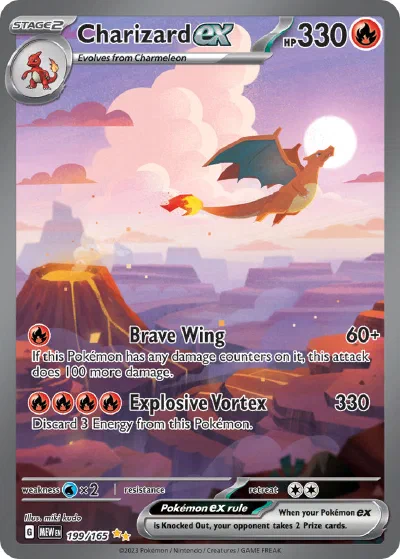
Charizard ex 183/165 is my budget-first choice because its market reference is the lowest on this shortlist. The PokemonTCG API record identifies it as the 151 Ultra Rare numbered 183, not the special illustration rare numbered 199. Check the number before paying; “151 Charizard” is not a precise description.
That API’s separate October 14 TCGplayer capture reports $38.35, while the TCGCSV capture used throughout this article reports $38.25. I have not averaged them or presented either as the price of a particular near-mint copy. A ten-cent difference between captured feeds is less important to a buyer than getting the printing and condition right.
At a $34 total checkout ceiling, Charizard uses relatively little of the budget. That is the reason for my preference—not a claim that its price must catch up with a more expensive Charizard.
Suicune V GG38/GG70 is my next watch for someone who specifically wants a Crown Zenith gallery card. Its $55.55 reference is $9.94 below Mew GG10’s $65.49 in the same feed. If you like both equally, that difference gives you a straightforward reason to start with Suicune. If you prefer Mew’s art, the saving is not an instruction to buy a card you don’t want.
At my target checkout totals, Charizard plus Suicune costs $83, leaving $17 of a $100 budget unspent. At their aggregate market figures, the pair totals $93.80 before any additional checkout costs. Neither calculation proves both cards are available at those amounts. It shows why I would wait for individual copies rather than treat two market rows as a ready-made shopping basket.
Which of the other seven deserves your money?
Mew GG10 versus Glaceon GG40: Their market references are $65.49 and $65.73. That is too small a difference to drive my choice between different cards. I would choose the artwork I actually wanted, then apply the $58 or $59 total limit. Both are Crown Zenith gallery printings; don’t substitute a cheaper regular-set Mew or a different Glaceon and call it the same comparison.
Charizard VSTAR SWSH262: The $66.20 market reference buys a different card and illustration from Charizard ex 183. My limit is $59 all-in. I would not buy both merely to “diversify”: two Charizard cards do not establish independent market risks, and this snapshot contains no correlation or sales-volume analysis.
Umbreon V TG22: The reference is $71.64 and my ceiling is $64. This is the Brilliant Stars Trainer Gallery V, not an Evolving Skies VMAX. If the listing leans on “Moonbreon” rather than clearly showing TG22/TG30, slow down. The name is not a substitute for the printing.
Zapdos ex 202/165: At $82.77 market, it passes the sticker-price screen, but my $74 checkout limit leaves more discipline than simply spending $99 because it is technically below the headline cap. This is a preference for a cheaper entry, not a forecast of a rebound.
Leafeon GG35 versus Glaceon GG40: Leafeon’s $85.90 market reference requires more of the budget than Glaceon’s $65.73. If you want either Eeveelution equally, I prefer the lower commitment. If Leafeon is the actual collection goal, waiting for a $77 total makes more sense than buying Glaceon as a consolation prize.
Palkia GG67: It qualifies at $96.34 market, but it is my least comfortable budget fit. With an illustrative 8% tax on the card and $4 delivery, checkout becomes $108.05: $96.34 × 1.08 + $4. Actual tax treatment varies. The point is to calculate your actual total, not import this example’s tax rate into your cart. My buy line is $86 all-in; a sub-$100 market headline alone does not earn a buy.
Fees can erase a perfectly ordinary resale gain
Buying under $100 is not the same as having a profitable exit. Here is a hypothetical—not a quotation of any marketplace’s current fee schedule.
Suppose your total acquisition cost is $60. You later sell for $65, pay an assumed 15% selling fee on that sale, and spend $5 on outbound delivery and packing. Your proceeds are $50.25: $65 × 0.85 − $5. That is below your original cost even though the sale price is higher.
Under those same simplified assumptions, break-even requires $76.47 gross, calculated as ($60 + $5) ÷ 0.85. Different fees, shipping charges, buyer-paid delivery and tax treatment change the answer. Replace the assumptions with your venue’s actual charges before making a resale decision.
I have not verified completed-sale counts, time-to-sale or condition-matched sales for these ten printings. There is no defensible “easy to sell” ranking here. For a copy you might resell, check recent comparable completed transactions and how many genuinely comparable listings remain. A market number is not a promise of liquidity.
If grading is part of your plan, use the grading-profit framework to include the fee and an unsuccessful grade—not just the best possible slab price. For evaluating a price feed itself, the TCGplayer chart guide explains why a single number needs context.
What would change this advice?
A new verified snapshot would move my mechanical offer limits. Photo-verified condition and recent condition-matched sales could justify rejecting a reference price altogether. None of the captured market rows certifies a reprint schedule or the remaining supply of a printing; extra supply is a risk, not an announcement I am making.
For now, I would watch Charizard 183 at $34 total or Suicune GG38 at $49 total, buy only if an acceptable copy actually meets the limit, and otherwise hold the cash. Existing owners do not need to sell merely because a new buyer’s offer line is below market. This is a purchase screen, not a sell signal.
The useful result is a card you wanted at a cost you understood. Filling the entire $100 budget is optional.